
The GreanBeams project aim is to quickly locate affordable hardwood for sale in your area and to buy beams or posts for structural uses. The site encourages the use of chunky softwood or solid hardwood beams rather than glulam beams and other highly processed timber.
Why choose timber from Greenbeams?
• We provide and advise on the use of robust and affordable hardwood that is green or semi-seasoned for use as joists, round wood beams, a timber lintel, a beam/purlin roof or a timber portal frame.
• Hardwood structures in our buildings provide an ideal carbon store that should prevent the carbon from being released back into the atmosphere through burning or rot and decay.
• Moreover a timber lintel can be used to replace a pre-cast concrete member or steel beam that would generate large amounts of greenhouse gasses in production. They also reduce the need for imported softwoods and highly processed gluelam beams.
• Some solid hardwood beams can have a greater durability than commonly used softwoods, concrete or even galvanised steel, especially in saline environments.
• Greenbeams can provide structural information about the different British hardwood species to help select the right type of engineered wood beams for your hardwood structure. Using timber is not only environmentally friendly, it looks good too, and therefore affordable hardwood can be used for exposed beams and ceilings.
• We believe in the use of British hardwood in modern engineering and architecture for a negative carbon future
Price
- It is usually cheaper to use a commercial timber joist (up to 300mm deep) for spans up to 5m than a steel beam. A combination of commercial timber joists can be used to improve capacity and make installation easier.
- Even though steel beams are likely to be cheaper than a bespoke hardwood beam, there are additional costs to factor in, for instance paying for a carpenter to disguise or fire-proof a steel beam. So often the solid hardwood beam works out cheaper.
Fire Protection
- In a fire, the outer surface of solid timber chars and protects the interior of the beam from the heat. It generally takes a fire more than an hour to reduce the required capacity from a 200mm thick timber beam. This can be designed as part of the structural process.
- Steel, and to a lesser extent concrete beams heat up in a fire if not protected. Steel loses a substantial percent of its structural capacity towards 1000 degrees.
- Timber is of course combustible. It is recommended that exposed corners (arises) are removed to make it more difficult for fire to get hold in a beam.
Splitting of Solid Timber

- There are also aesthetic and other safety reasons for removing arises from solid timber. Changes in relative humidity can result in cracks opening up and closing, and the timber twisting. The visual impact of such movements and the risk of snagging on splinters is reduced if sharp arises are removed.
- There are advantages in allowing solid timber to dry out or cure prior to insertion into structures. The Greenbeams project has discovered that most hardwood timbers dry out around ten times faster than oak.
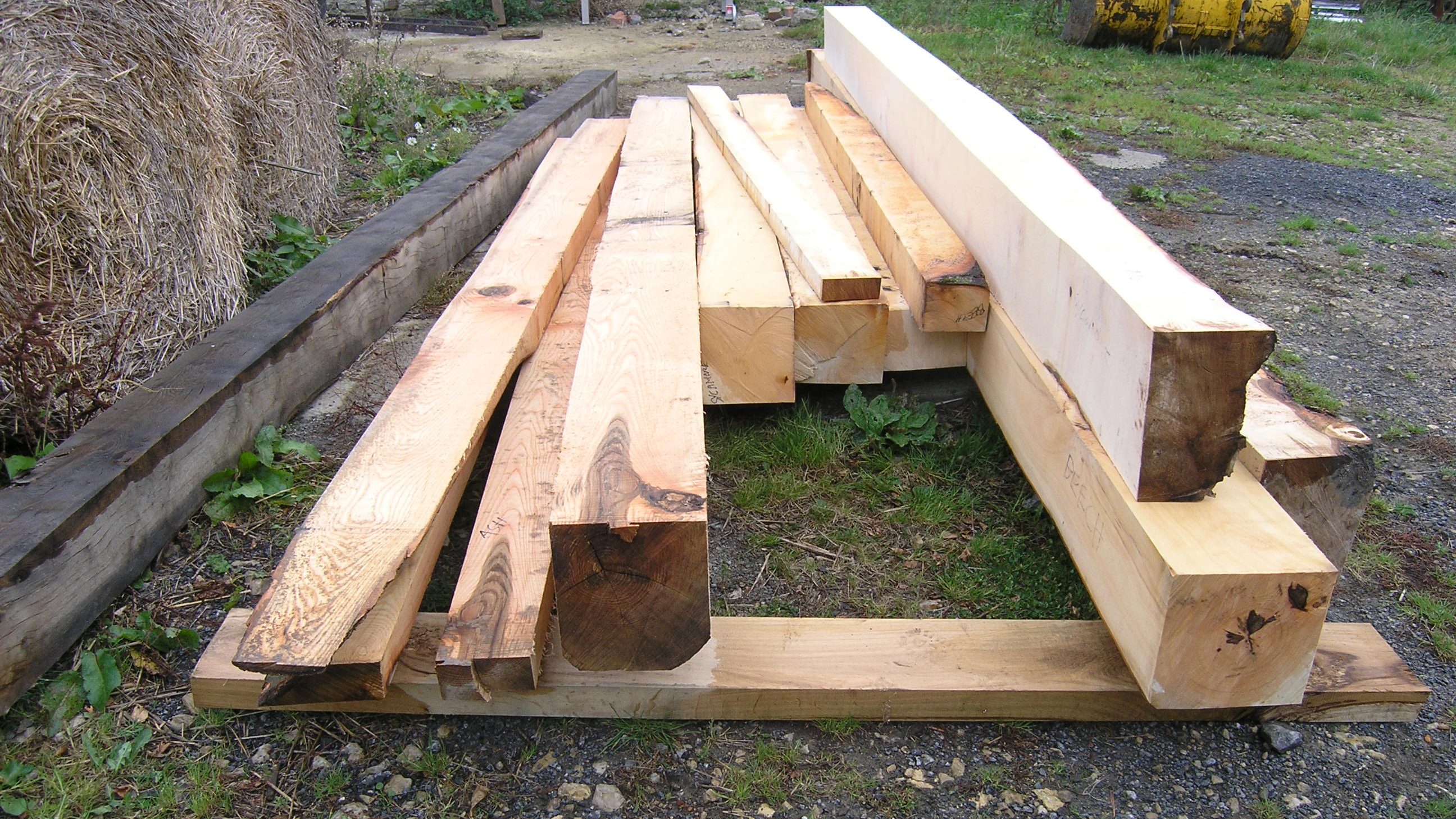
- Ash is particularly prone to twisting and cracking as it dries. The heart of the trunk should not be ‘boxed’ during the sawing process to avoid “L” shaped cracks which can significantly reduce the capacity of a beam.
- Vertical cracks tend to have little structural significance.
- Horizontal cracks down the centre may have little effect on the structural capacity, if the cracks are short, but need to be assessed in design.
 GreenBeams